Definitions:
light-year, light-second, light-minute
speed of light
meter
second
kilogram
celestial sphere (and related points on it)
asterisms vs. constellations
analemma
declination and RA (right ascension) - how they compare to latitude and longitude
equinoxes and solstices
circumpolar stars
international date line
electromagnetic (EM) spectrum
speed = frequency x wavelength
Know:
the brightest objects in this evening's sky
a couple of asterisms
how to find north
some way to remember the speed of light
how the sequence of radiation on the EM spectrum "works"
Thursday, June 9, 2016

Light
Big Distances
Consider light as a means of measurement. The speed of light (in a vacuum) is:
c = 3E8 m/s
(Which is around 186,000 miles per second or 670 million miles per hour, or nearly 7 times around the Earth's equator in one second.)
Since v = d/t, we see that d = v t.
Using light's speed, we can define a light-second:
1 LS = 3E8 m = 300,000,000 meters (or about 186,000 miles)
Similarly, a light year:
1 LY = 9.4607 E12 km (or nearly 6 trillion miles)
WAVES!
Let's talk some more about "light." What is it?
Consider first a "wave" -

Energy
can, as it turns out, travel in waves. In fact, you can think of a
wave as a traveling disturbance, capable of carrying energy with it.
For example, light "waves" can have energy - like solar energy. Ocean
waves can certainly carry energy.

We care primarily about the electromagnetic (e/m) waves:


There are several wave characteristics (applicable to most conventional waves) that are useful to know:
amplitude - the "height" of the wave, from equilibrium (or direction axis of travel) to maximum position above or below
crest - peak (or highest point) of a wave
trough - valley (or lowest point) of a wave
wavelength (lambda - see picture 2 above) -
the length of a complete wave, measured from crest to crest or trough
to trough (or distance between any two points that are in phase - see
picture 2 above). Measured in meters (or any units of length).
frequency (f) - literally, the number of complete waves per second. The unit is the cycle per second, usually called: hertz (Hz)
wave speed (v) -
the rate at which the wave travels. Same as regular speed/velocity,
and measured in units of m/s (or any unit of velocity). It can be
calculated using a simple expression:
There are 2 primary categories of waves:
Mechanical – these require a medium (e.g., sound, guitar strings, water, etc.)
Electromagnetic –
these do NOT require a medium and, in fact, travel fastest where is
there is nothing in the way (a vacuum). All e/m waves travel at the same
speed in a vacuum (c, the speed of light):
c = 3 x 10^8 m/s
We care primarily about the electromagnetic (e/m) waves:
General breakdown of e/m waves from low frequency (and long wavelength) to high frequency (and short wavelength):
Radio
Microwave
IR (infrared)
Visible (ROYGBV)
UV (ultraviolet)
X-rays
Gamma rays
In detail, particularly the last image:
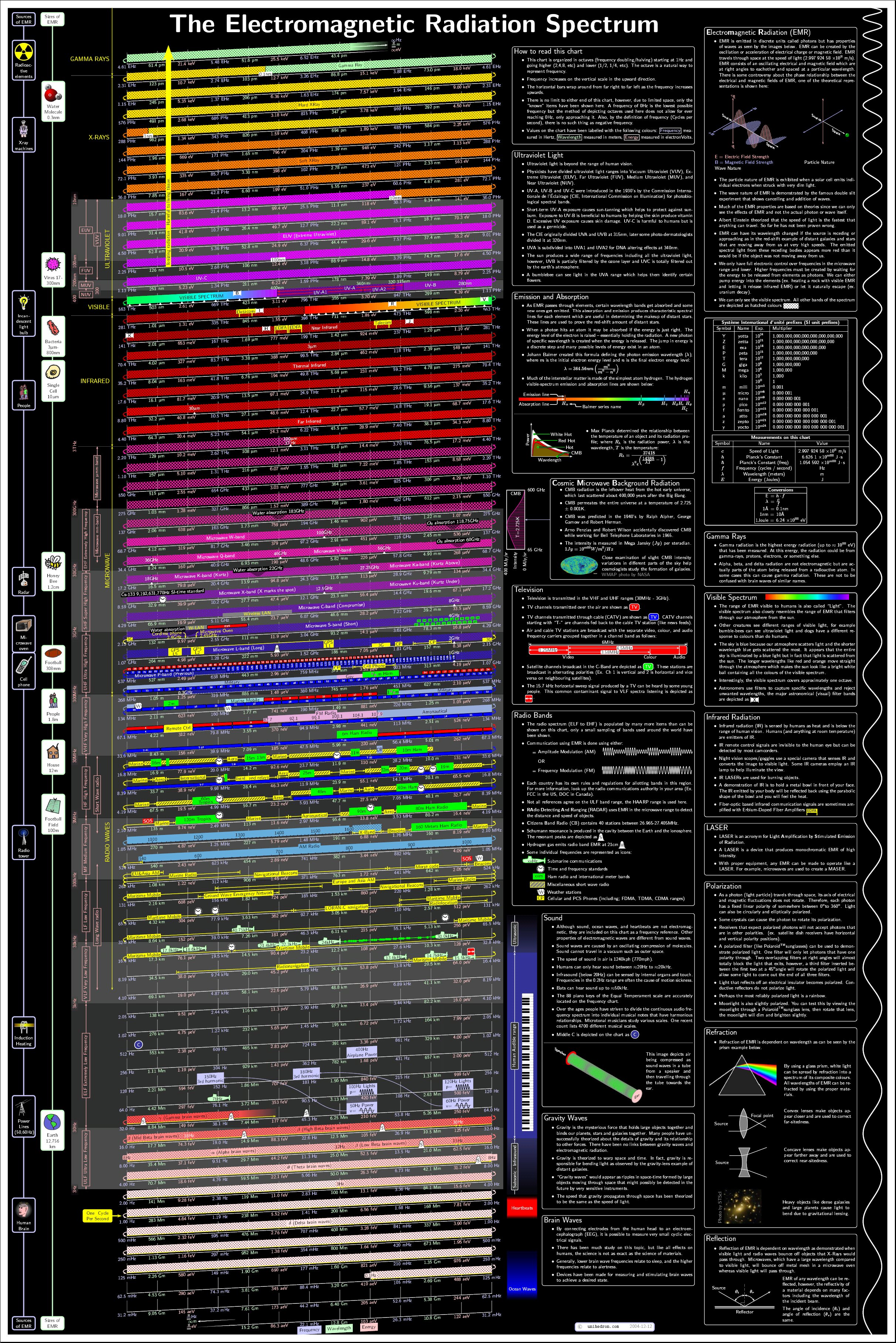
ALL EM waves (in a vacuum) travel at the SPEED OF LIGHT (c).

Tuesday, June 7, 2016
Homework #1 - due next class
Please provide brief answers to each of the following:
1. Describe how to find your way North using the stars.
2. What are the brightest objects in this evening's sky? (If you do not have a star chart, you can find one at skymaps.com)
3. Under the most ideal circumstances, approximately how many stars would you see (without the aid of a telescope) in dark skies?
4. What is the speed of light? Also give an easy alternate definition (or simpler approximation for it).
5. Draw an approximate picture of the celestial sphere and identify: both equinoxes, both solstices, the celestial sphere, the ecliptic.
6. What exactly is the ecliptic (or ecliptic plane)?
7. What was the original definition of the meter, and what is it now based on?
8. Name 2 pieces of evidence that suggest that the Earth is spherical (or close to it). Consider only the evidence that ancient people might have known.
9. Given the photographs shown in class, come up with a way to describe the difference (in size) between the Sun, Arcturus, and Antares.
1. Describe how to find your way North using the stars.
2. What are the brightest objects in this evening's sky? (If you do not have a star chart, you can find one at skymaps.com)
3. Under the most ideal circumstances, approximately how many stars would you see (without the aid of a telescope) in dark skies?
4. What is the speed of light? Also give an easy alternate definition (or simpler approximation for it).
5. Draw an approximate picture of the celestial sphere and identify: both equinoxes, both solstices, the celestial sphere, the ecliptic.
6. What exactly is the ecliptic (or ecliptic plane)?
7. What was the original definition of the meter, and what is it now based on?
8. Name 2 pieces of evidence that suggest that the Earth is spherical (or close to it). Consider only the evidence that ancient people might have known.
9. Given the photographs shown in class, come up with a way to describe the difference (in size) between the Sun, Arcturus, and Antares.
Monday, June 6, 2016
More about the Speed of Light
What about.....
The Speed of light
Speed of light (in a vacuum) -
This number is a physical constant, believed to be true everywhere in the universe. The letter c is used to represent the value being of constant celerity (speed).
By the way, it's hard to remember this exact number, and I wouldn't expect you to. However, here are some approximations that may make it easier to keep it in mind. The speed of light is approximately:
- 300,000,000 meters/sec
- 186,000 miles/sec
- 7 times around the Earth's equator in 1 second
- Out to the Moon in around 1 second (1.3 seconds is closer) - so, the Moon is approximately 1.3 "light seconds" away (on average)
- To the Sun in about 8 minutes - so, the Sun is approximately 8 "light-minutes" away (on average)
- To Mars in about 13 minutes, though this varies depending on the relative locations of Earth and Mars in their respective orbits
- To the nearest (non-Sun) star, actually a 3-star system (Alpha Centauri A and B, and Proxima Centauri) in 4.3 years. Yes, YEARS. So, that 3-star system is around 4.3 "light years" away from us. And that's our closest neighbors!! See why we don't get too far in space travel?
The Speed of light
Speed of light (in a vacuum) -
c = 299,792,458 m/s
This number is a physical constant, believed to be true everywhere in the universe. The letter c is used to represent the value being of constant celerity (speed).
By the way, it's hard to remember this exact number, and I wouldn't expect you to. However, here are some approximations that may make it easier to keep it in mind. The speed of light is approximately:
- 300,000,000 meters/sec
- 186,000 miles/sec
- 7 times around the Earth's equator in 1 second
- Out to the Moon in around 1 second (1.3 seconds is closer) - so, the Moon is approximately 1.3 "light seconds" away (on average)
- To the Sun in about 8 minutes - so, the Sun is approximately 8 "light-minutes" away (on average)
- To Mars in about 13 minutes, though this varies depending on the relative locations of Earth and Mars in their respective orbits
- To the nearest (non-Sun) star, actually a 3-star system (Alpha Centauri A and B, and Proxima Centauri) in 4.3 years. Yes, YEARS. So, that 3-star system is around 4.3 "light years" away from us. And that's our closest neighbors!! See why we don't get too far in space travel?
Time
Notes on Time
A discussion on Time:The second is the fundamental unit of time. It was originally defined as: - the amount of time required for a 1-m pendulum to swing from one side of arc to the other
Now, it is defined as: 9 192 631 770 cycles of radiation corresponding to the transition between two hyperfine levels in the ground state of Cesium-133
Worth noting: There are approx 365 1/4 mean solar days in one solar year (watch time). The mean solar day is the average length of a solar day, 24 hours.
Solar year - the time between 2 vernal equinoxes. This is actually the tropical year, which is growing shorter by 0.5 sec/century. 1900 is the standard tropical year.
Sidereal time - time by the stars
Sidereal year - the amount of time for the Sun to return to a given position among stars
Calendars:
Julian - 365 days with an extra day every 4 years (leap year).
This was still a bit imprecise - consider that in 1988, the year was 365 d, 5 h, 48 min, 43.5 s. By 1582, the Julian calendar was out of phase with Easter by nearly 10 days. So, Pope Gregory XIII adopted a new calendar; 10 days were dropped from that year.
Gregorian calendar -
Years evenly divible by 4 are leap years. Every 4th century year is a leap year (2000, 2400; NOT 1600, 1700, 1800, 1900, 2100)
Daylight savings time
http://en.wikipedia.org/wiki/Daylight_saving_time
http://www.timeanddate.com/time/dst/
Changed a few years back. Now: DST Starts at 2 AM, second Sunday in March - set clocks AHEAD 1 hour
DST Ends at 2 AM, first Sunday in November - set clocks back (to standard time) 1 hour
We are EST, Eastern Standard Time. During DST, we become EDT (Eastern daylight time).
Greenwich Mean Time (GMT) - 5 hours ahead of EST. Roughly the same as Universal Time (UT).
Universal time (UT)
Basically the mean solar time as measured on the Greenwich meridian, thus, 5 hours ahead of us. Formally, UT is defined by a mathematical formula as a function of sidereal time and is thus determined by observations of stars, and kept via atomic clock
Sidereal time
In 365 1/4 solar days, Earth makes 366 1/4 rotations on its own axis. So, there are 366 1/4 sidereal days in a solar year. Each sidereal day is shorter by about 4 minutes than a solar day. UT and GST agree at one instant every year (at the autumnal equinox, around Sep 22). Thereafter, the difference between them grows, in the sense that ST runs faster than UT until exactly half a year later, when it is 12 hours. Another half-year later, the times again agree.
Greenwich Sidereal Time
local sidereal time on the Greenwich meridian
Julian Date (JD)
Jan 1, 4713 BC is the fundamental epoch from which this is decided. The Julian date is the number of days since this day.
There is no year 0 in astronomy. The year before 1 AD is defined as year 0. So, 10 BC is the year -9 in astronomy. That trick again: to go from BC year to astro year, subtract one and change sign.
Coordinate systems
Coordinate Systems
Celestial Sphere - points to know:- Both Equinoxes
- Both Solstices
Celestial north
Celestial south
Ecliptic
Celestial equator
Coordinates:
On Earth:
Longitude
half-circle lines from North to South pole
Zero longitude runs through the site of the Royal Greenwich Observatory in England - the Prime Meridian (0 degrees long.)
Number of degrees east or west of the PM
Latitude
Full circle lines parallel to the equator (0 degrees latitude)
+ or - 90 degrees corresponds to the poles
International Date Line (IDL)
Near or along 180 degrees longitude line, through the Pacific Ocean
As we travel eastward around the globe, the hours get later roughly each 15 degrees (a time zone). When we cross the IDL, we go BACK one day. This keeps only 24 hours on the Earth at a time.
In the Sky:
Celestial Equator - imaginary line above the Earth's equator
Right Ascension (RA)
Celestial analog of longitude (both measure east-west)
Measured in hours (each hour of RA equals 15 degrees) along the celestial equator
Declination (dec)
Celestial analog of latitude (both measure north-south)
Measured perpendicularly above (+) or below (-) the celestial equator
RA and dec form a coordinate system fixed to the stars. To observers on Earth, the stars appear to revolve every 23 h 56 min. So, the coordinate system appears to revolve at the same rate. Of course, it is the Earth which is really moving (most noticeably).
Ecliptic
Although the stars are fixed in their positions in the sky, the Sun's position varies through the whole range of RA throughout the year. This path (the "apparent" path of the Sun) is called the ecliptic and is inclined 23.5 degrees with respect to the celestial equator (CE), since the Earth's axis is tipped by that amount. (The "ecliptic plane" is the plane that the Earth and Sun make.)
The ecliptic and CE cross at two points:
Vernal equinox
March 21 (approx)
the first day of Northern Hemisphere spring
the zero-point of RA
Sun's declination is 0 degrees
Nearly equal amounts of day and night
Autumnal equinox
Sep 23 (approx)
the first day of autumn
Sun's declination at 0 degrees
Nearly equal amounts of day and night
Two other noteworthy days:
Winter solstice
Dec 22 (approx)
Shortest day of the year in Northern hemisphere
9.5 h of daylight (in the DC area)
As you travel farther north, the days are even shorter
- in Anchorage, Alaska, the day will be 5 h long
- in Barrow, Alaska, the sun will not "come out" at all; noontime is like deep twilight
the North pole is angled most steeply away from the Sun
Summer solstice
June 21 (approx)
longest day of the year in the Northern hemisphere
amount of tipping toward Sun is greatest for N. hemisphere
Sun highest in sky (dec is 23.5 degrees)
Length of daylight depends on latitude, calendar date, but not longitude
Each point on the globe receives an average of 12 hours of light each day. So, students in Barrow, Alaska have several days of endless sunshine as well.
Since the Moon goes around the Earth, its RA changes through the entire range of values each month. Since its orbit is inclined to the CE, its dec also changes.
The Celestial Sphere concept
Celestial Sphere

Celestial sphere sites
The first site allows you to simulate the apparent motion of the Sun around the Earth for any day of the year (and location). It's really cool to play around with.
>
The analemma - the "apparent" path of the Sun around the Earth


Subscribe to:
Posts (Atom)